



WASHINGTON, D.C. (LOOTPRESS) – President Donald Trump is pushing back against growing opposition to data center development across the United States, arguing that communities rejecting the massive facilities risk becoming “backwards and poor.”
In a Truth Social post Monday morning, Trump strongly defended data centers and the economic benefits he says they can bring to communities.
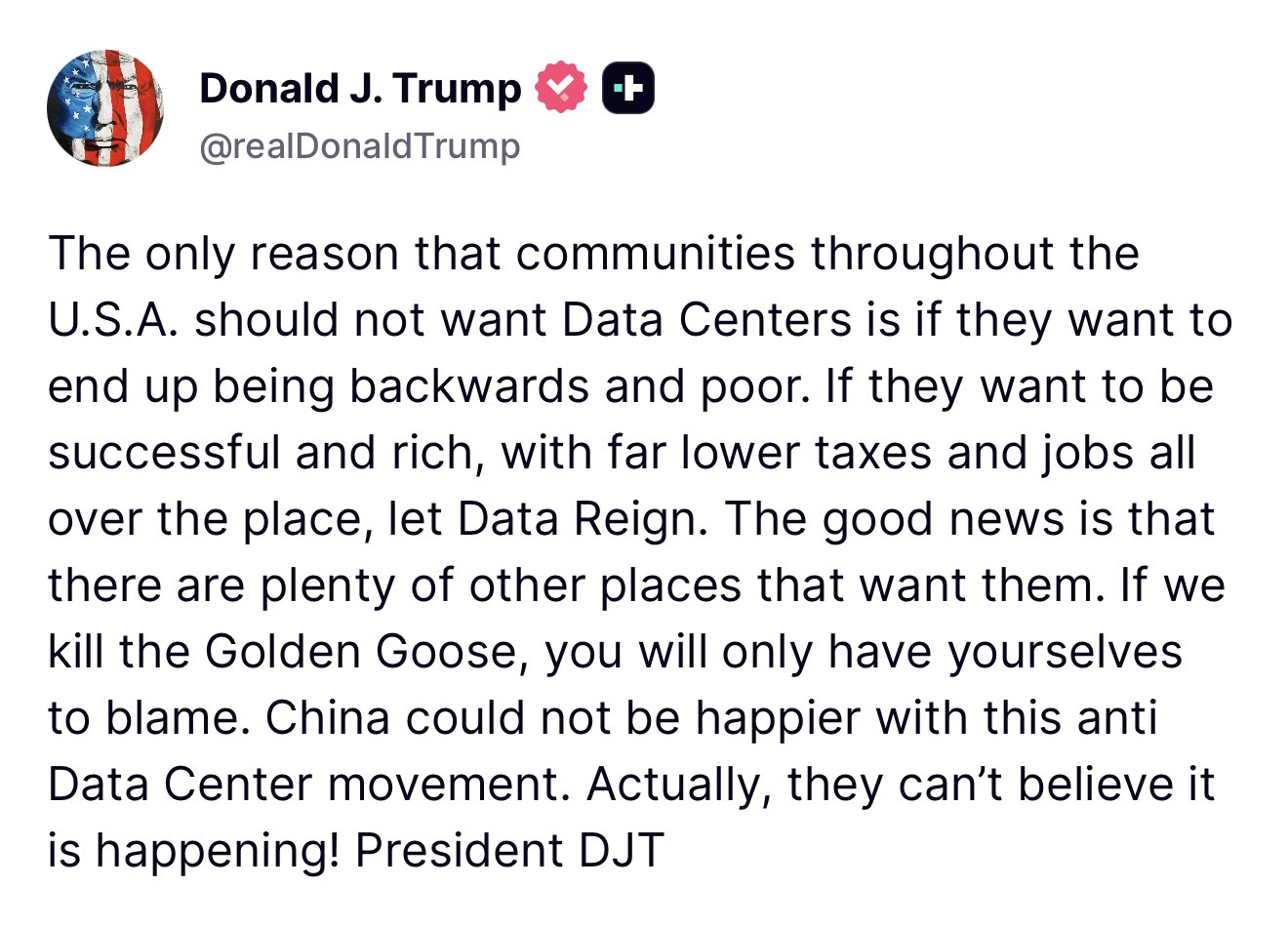
“The only reason that communities throughout the U.S.A. should not want Data Centers is if they want to end up being backwards and poor,” Trump wrote. “If they want to be successful and rich, with far lower taxes and jobs all over the place, let Data Reign.”
Trump also warned that communities rejecting the projects could lose investments to other areas willing to accept them.
“The good news is that there are plenty of other places that want them,” Trump wrote. “If we kill the Golden Goose, you will only have yourselves to blame.”
The president tied the issue to competition with China, saying the country “could not be happier with this anti Data Center movement.”
Data centers are large facilities filled with servers and other computing equipment used to store and process information.
While they have long supported websites, cloud computing and other online services, demand has accelerated as technology companies build increasingly powerful facilities needed to develop and operate artificial intelligence systems. More than 4,000 data centers are currently operating in the United States, according to Pew Research Center.
Trump’s comments come as opposition to data centers has grown in communities across the country, including among both Republicans and Democrats.
Residents and local officials have raised concerns about the enormous amounts of electricity some facilities require, their potential impact on electric rates and power-grid reliability, water consumption for cooling systems, noise, pollution and the loss of farmland or other developable property. Critics have also questioned whether the permanent jobs created by data centers justify tax incentives sometimes offered to attract the projects.
Those concerns have led some communities to delay projects or impose temporary moratoriums while local governments consider new regulations. In Texas, Gov. Greg Abbott recently ordered a pause on approvals for new data centers seeking connections to the state’s electric grid until their impacts can be reviewed.
Public opinion also reflects those concerns. A Pew Research Center survey conducted in January found 38% of Americans believed data centers were mostly bad for home energy costs, compared with 6% who considered them mostly good. Thirty-nine percent viewed their environmental impact negatively. At the same time, Americans were more likely to view data centers positively when it came to local jobs and tax revenue.
Supporters argue the facilities can generate significant property tax revenue, construction work and other economic activity while providing infrastructure necessary for the country’s rapidly expanding AI industry.
Trump has repeatedly made a similar argument, maintaining that the United States needs continued data center development to compete globally, particularly with China.
The debate has increasingly become a political issue ahead of the November midterm elections, with opposition emerging in communities across the political spectrum as the number and size of proposed facilities continues to grow.


