


(LOOTPRESS) – The number of people incarcerated in U.S. prisons increased again in 2023, marking the second straight year of growth after a decade of declines — though national totals remain below historic highs.
According to the latest federal data, about 1.25 million people were held in state and federal prisons at the end of December 2023, a 2% increase from 2022. Nearly all — 96.5% — were serving sentences of one year or longer.
Most incarcerated individuals were housed in government-run institutions, with 87.7% of prisoners held in federal and state facilities. The remaining population was split between private prisons and local jails, depending on how states manage custody.
Federal corrections officials have sharply reduced reliance on privately run facilities in recent years. As of 2022, all federal prisoners in private custody were placed in halfway houses or home confinement rather than secure private prisons, following the Bureau of Prisons’ decision to end contracts with private secure facilities in November 2022.
States, however, continue to use a mix of custody arrangements, with some relying heavily on local jails or private operators.
Louisiana reported the highest share of state prisoners housed in local jails, with more than half of its incarcerated population held outside traditional prison facilities. Montana reported the largest share of prisoners in private prisons, with nearly half of its prison population housed in privately operated institutions — the highest rate in the nation.
Nationwide, 5.2% of all prisoners are housed in local jails and 7.1% are in private prisons.
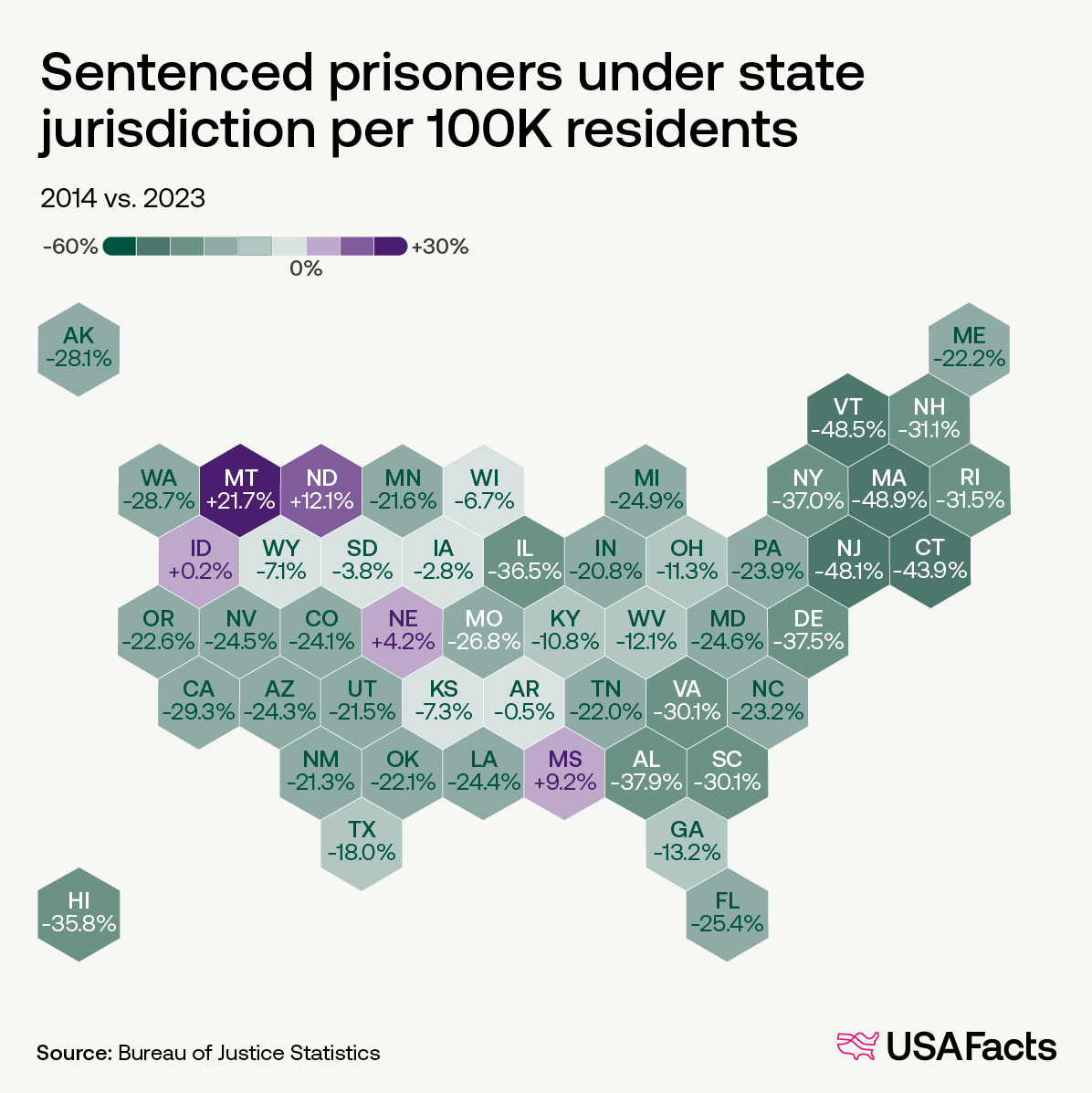
While the national prison population has recently inched upward, incarceration rates have shifted unevenly across the states over the past decade. From 2014 to 2023, incarceration rates fell in 45 states and increased in five.
Massachusetts recorded the largest decline, dropping 48.9%, from 188 prisoners per 100,000 residents to 96. Montana experienced the largest increase, rising 21.7%, from 360 prisoners per 100,000 people to 438.
Researchers say the data reflect a complex combination of sentencing policies, parole practices, criminal justice reforms, and post-pandemic system changes that vary widely across states.
Despite the recent uptick, the nation’s prison population remains below prior peaks seen in the late 2000s and early 2010s — a sign, analysts say, that long-term shifts in incarceration policy continue to reshape the U.S. correctional system.