


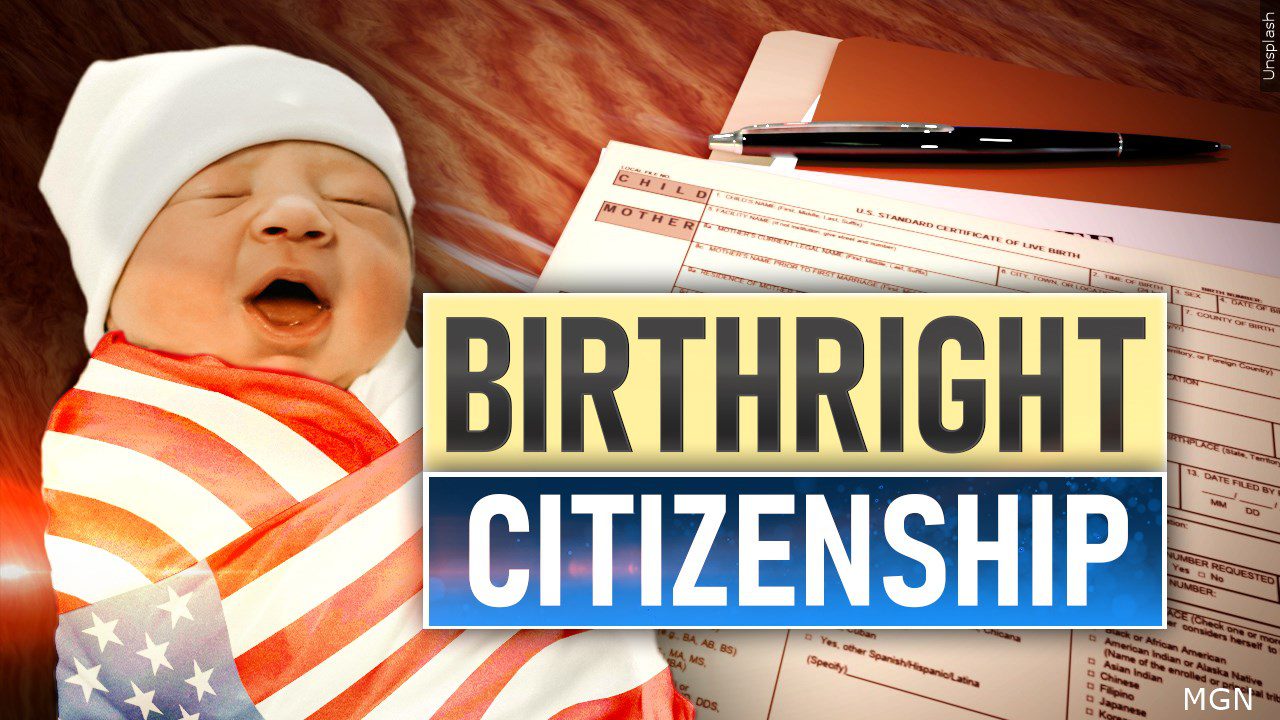
WASHINGTON, DC (LOOTPRESS) – The U.S. Supreme Court on Friday set the stage for a landmark decision by agreeing to review the legality of President Donald Trump’s controversial initiative to sharply restrict birthright citizenship. The outcome—anticipated by late June—could determine whether Trump’s effort to redefine a foundational principle of American citizenship can proceed.
The dispute, which originated in New Hampshire, represents one of the most consequential clashes yet between a president known for aggressively wielding executive authority in his second term and a court whose 6–3 conservative majority has so far sidestepped major confrontations with the administration.
A Constitutional Tradition Under Scrutiny
For more than 150 years, birthright citizenship has been understood as a guarantee of the 14th Amendment, which affirms that “all persons born or naturalized in the United States, and subject to the jurisdiction thereof, are citizens of the United States.” Ratified after the Civil War, the provision was crafted to ensure that formerly enslaved people and their children would be recognized as full citizens.
Across generations, legal scholars—regardless of ideological leaning—have viewed the amendment’s language as largely definitive. Exceptions have historically been limited to the children of diplomats, individuals from hostile occupying forces, and certain Native American tribes before specific legislative changes.
Trump’s immigration team, however, has embraced a legal theory long relegated to the margins of academic debate. The administration argues that the amendment’s jurisdiction clause extends citizenship only to children whose parents owe formal allegiance to the United States.
The Administration’s Position
Under the proposed policy, automatic citizenship would apply solely to those born to at least one U.S. citizen or lawful permanent resident. Children born to undocumented immigrants, as well as to foreign nationals visiting the U.S. on temporary visas, would not qualify.
Solicitor General D. John Sauer, defending the policy, contends that previous interpretations misconstrued the amendment by equating mere presence on U.S. soil with eligibility for citizenship.
Sauer wrote that the widespread modern understanding of birthright citizenship emerged “long after the Clause’s adoption” and has produced “destructive consequences.” The administration says the new limits would “restore the Clause’s original meaning.”
A Policy Blocked—So Far
Unveiled on Trump’s first day in office, Jan. 20, the policy has faced stiff resistance in federal courts nationwide. Judges in multiple jurisdictions—including Washington state and New Hampshire—have ruled the executive order unlawful. As a result, the administration has not implemented the changes.
The Supreme Court has intervened once before, siding with the administration on a procedural issue by ruling that lower courts lacked authority to impose nationwide injunctions. But that decision did not address whether the executive action itself is lawful.
The case now before the justices includes individual plaintiffs represented by the American Civil Liberties Union, among them two infants who would lose citizenship rights under the new rules. The Court declined to take up a related lawsuit filed by Washington, Arizona, Illinois, and Oregon.
A Court Facing an Array of Executive Power Tests
While the Supreme Court has generally ruled favorably for the administration in several cases this year, many legal analysts believe the birthright citizenship challenge may break that pattern. The issue is widely seen as a direct test of constitutional text and historical intent—terrain where justices across the ideological spectrum may diverge sharply from the administration’s reading.
The case is one of several looming showdowns over Trump’s use of executive authority. A ruling on his sweeping tariff powers is expected imminently, and the Court will soon consider his authority to remove leaders of key federal institutions, including the Federal Reserve.
As these disputes converge, the Court is poised to deliver a series of decisions that could reframe the limits and reach of presidential power for years to come.